Showing posts with label Russia. Show all posts

Saturday, April 26, 2025

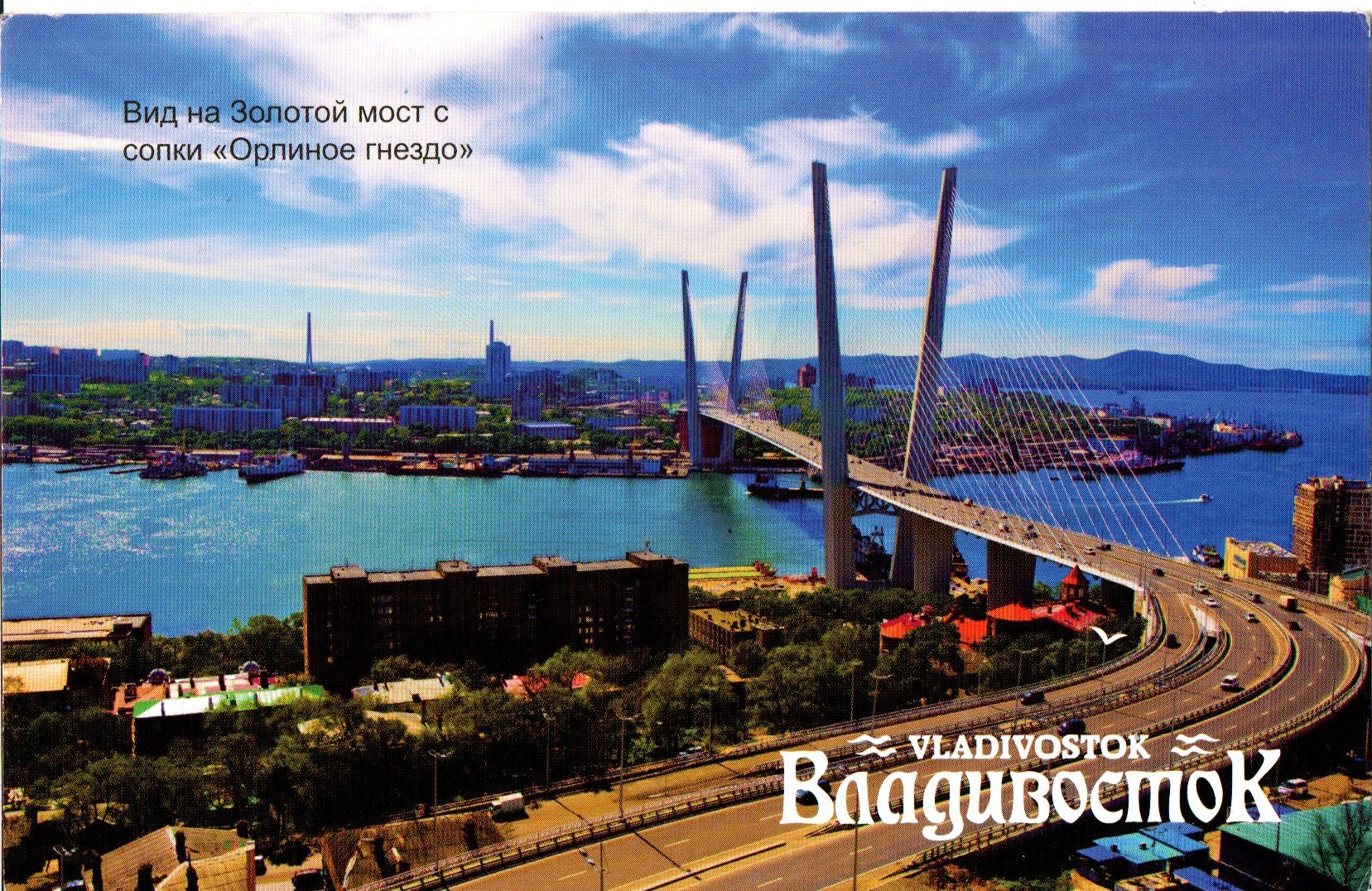
Russia: The Zolotoy Bridge

The Zolotoy Bridge ('Golden Bridge') is a cable-stayed bridge across the Zolotoy Rog (Golden Horn Bay) in Vladivostok, Russia. This bridge over Golden Horn Bay made it possible to travel from the centre of Vladivostok to the remote Churkin Cape in only 5–10 minutes instead of the usual 1.5–2 hours.


 Thanks to Ms Irina

Saturday, August 28, 2021

Russia: Aeroflot IL18

The Ilyushin Il-18 is a large turboprop airliner that first flew in 1957 and became one of the best known and most durable Soviet aircraft of its era. The Il-18 was one of the world's principal airliners for several decades and was widely exported. Due to the aircraft's airframe durability, many examples achieved over 45,000 flight hours and the type remains operational in both military and (to a lesser extent) civilian capacities. The Il-18's successor was the long range Il-62 jet airliner.


Thanks to Ms Aleksandra. The stamp she used is a 2020 joint-issue with South Korea featuring a brown bear. she has also used a  Postcrossing stamp that was issued in 2016 along with a 3p definitive.
 

Saturday, May 11, 2019

Russia: Peterhof Palace

The Peterhof Palace is a series of palaces and gardens located in Petergof, Saint Petersburg, Russia, commissioned by Peter the Great as a direct response to the Palace of Versailles by Louis XIV of France. Thepalace-ensemble along with the city center is recognized as a UNESCO World Heritage Site.


Thanks to Ms Svetelana. Nice bus tickets along with stamps.

Thursday, March 14, 2019

Russia: Samovars

A samovar is a heated metal container traditionally used to heat and boil water in Russia. Since the heated water is typically used to make tea, many samovars have a ring-shaped attachment around the chimney to hold and heat a teapot filled with tea concentrate. Though traditionally heated with coal or charcoal, many newer samovars use electricity to heat water in a manner similar to an electric water boiler. Antique samovars are often prized for their beautiful workmanship.


Thanks to Ms Tamara.

Friday, August 3, 2018

Russia: FIFA World Cup 2018

The 2018 FIFA World Cup was the 21st FIFA World Cup, an international football tournament contested by the men's national teams of the member associations of FIFA once every four years. It took place in Russia from 14 June to 15 July 2018. At an estimated cost of over $14.2 billion, it was the most expensive World Cup. It was also the first World Cup to use the video assistant referee (VAR) system. The finals involved 32 teams, of which 31 came through qualifying competitions, while the host nation qualified automatically. The final took place on 15 July at the Luzhniki Stadium in Moscow, between France and Croatia. France won the match 4–2 to claim their second World Cup title, marking the fourth consecutive title won by a European team.


Tuesday, April 3, 2018

Russia: Solovetsky Monastery

The Solovetsky Monastery is a fortified monastery located on the Solovetsky Islands in the White Sea in northern Russia. The Solovetsky Monastery was founded in 1436 by the monk Zosima, however, monks German and Savvatiy from the Kirillo-Belozersky Monastery lived on the island from 1429 to 1436, and are considered to be co-founders of the monastery. 


Thanks to Ms Elen and Mr Alex.

Friday, April 21, 2017

Russia: Cuisine of Russia

Russian cuisine is a collection of the different cooking traditions of the Russian people. The cuisine is diverse, with Central European, Middle Eastern and Central Asian influences as Russia is by area the largest country in the world. Russian cuisine derives its varied character from the vast and multi-cultural expanse of Russia. Moreover, it is necessary to divide Russian traditional cuisine and Soviet cuisine, which has its own peculiarity. Its foundations were laid by the peasant food of the rural population in an often harsh climate, with a combination of plentiful fish, pork, poultry, caviar, mushrooms, berries, and honey. Crops of rye, wheat, barley and millet provided the ingredients for a plethora of breads, pancakes, pies, cereals, beer and vodka.


Thanks to Ms Timofey.

Saturday, April 15, 2017

Russia: Blagoveschensky Monastary, Novgorod

The architectural ensemble of Nizhni Novgorod Blagoveschensky monastery was founded in XIII century and was an advanced post, protecting the city from the Oka river side. After the October revolution this monastery was closed, and in its walls were placed citizens cultural and public service institution, a lot of main liturgia things were stolen.In 70-80th years of XX cent. began a partial restoration of some monastery constructions. 1991 year one can call as the year of revival of Blagoveschensky cathedral.Now the monastery ensemble consists of five church building and three frames of monastery residence, which were trimmed not high stone wall.


Thanks to 

Monday, January 4, 2016

Russia: St Petersburg Big Port

The port St.-Petersburg is located on islands of Neva Delta, in Neva Bay in east part of gulf of Finland of Baltic sea. Big port St.-Petersburg includes moorings of sea trading, wood, fish and river ports, the oil terminal, shipbuilding, ship-repair and other factories, sea passenger station, river passenger port, and also moorings.

Thanks to Mr Valdimir

Wednesday, November 18, 2015

Russia: Kizhi Pogost

Kizhi Pogost is a historical site dating from the 17th century on Kizhi island. The island is located on Lake Onega in the Republic of Karelia (Medvezhyegorsky District), Russia. The pogost is the area inside a fence which includes two large wooden churches (the 22-dome Transfiguration Church and the 9-dome Intercession Church) and a bell-tower. The pogost is famous for its beauty and longevity, despite that it is built exclusively of wood.


Thanks to Ms Sasha.

Thursday, November 12, 2015

Russia: Lake Baikal

Lake Baikal is a rift lake in Russia, located in southernSiberia, between Irkutsk Oblast to the north west and the Buryat Republic to the southeast. Lake Baikal is the largest (by volume) freshwater lake in the world, containing roughly 20% of the world's unfrozen surface fresh water. With a maximum depth of 1,642 m (5,387 ft), Baikal is the world's deepest lake. It is considered among the world's clearest lakes and is considered the world's oldest lake at 25 million years. It is the seventh-largest lake in the world by surface area. With 23,615.39 km3 (5,700 cu mi) of fresh water,it contains more water than all the North American Great Lakes combined.


Thanks to Ms Lena

Saturday, May 16, 2015

Russia: The Cathedral of Christ the Redemeer.

The Cathedral of Christ the Saviour is a cathedral in Moscow, Russia, on the northern bank of the Moskva River, a few blocks southwest of the Kremlin. With an overall height of 103 metres (338 ft), it is the tallest Orthodox Christian church in the world.


Thanks to Ms Daria.

Friday, September 14, 2012

Russia: Volcanoes of Kamchatka

This is one of the most outstanding volcanic regions in the world, with a high density of active volcanoes, a variety of types, and a wide range of related features. The six sites included in the serial designation group together the majority of volcanic features of the Kamchatka peninsula. The interplay of active volcanoes and glaciers forms a dynamic landscape of great beauty. The sites contain great species diversity, including the world's largest known variety of salmonoid fish and exceptional concentrations of sea otter, brown bear and Stellar's sea eagle. 


Thanks to Ms Larisa.

Russia: Historical Centre of the City of Yaroslavl

Situated at the confluence of the Volga and Kotorosl Rivers some 250 km north-east of Moscow, the historic city of Yaroslavl developed into a major commercial centre from the 11th century. It is renowned for its numerous 17th-century churches and is an outstanding example of the urban planning reform Empress Catherine the Great ordered for the whole of Russia in 1763. While keeping some of its significant historic structures, the town was renovated in the neoclassical style on a radial urban master plan. It has also kept elements from the 16th century in the Spassky Monastery, one of the oldest in the Upper Volga region, built on the site of a pagan temple in the late 12th century but reconstructed over time.

Postcard 1
 The card features Elijah the Prophet Church and on the right Spaso Preobrazhensky Cathedral.


Thanks to Ms Larisa.

Postcard 2


Thanks to Ms Irina for the nice card what looks like a card issued by Russian post.

Friday, August 17, 2012

Russia: Historic Monuments of Novgorod and Surroundings

Situated on the ancient trade route between Central Asia and northern Europe, Novgorod was Russia's first capital in the 9th century. Surrounded by churches and monasteries, it was a centre for Orthodox spirituality as well as Russian architecture. Its medieval monuments and the 14th-century frescoes of Theophanes the Greek (Andrei Rublev's teacher) illustrate the development of its remarkable architecture and cultural creativity. St Nicholas Cathedral founded by Mstislav the great in 1113 is featured on the card.


Thanks to Ms Ksenia.

Thursday, August 16, 2012

Russia: Historic and Architectural Complex of the Kazan Kremlin

Built on an ancient site, the Kazan Kremlin dates from the Muslim period of the Golden Horde and the Kazan Khanate. It was conquered by Ivan the Terrible in 1552 and became the Christian See of the Volga Land. The only surviving Tatar fortress in Russia and an important place of pilgrimage, the Kazan Kremlin consists of an outstanding group of historic buildings dating from the 16th to 19th centuries, integrating remains of earlier structures of the 10th to 16th centuries. Shown on the card is Annuciation Cathedral (1554-62), which is the oldest building in the complex and only church to have 6 piers and five apses.


Thanks to Ms Aletta. 

Friday, June 22, 2012

Russia: Historic Centre of Saint Petersburg.

The 'Venice of the North', with its numerous canals and more than 400 bridges, is the result of a vast urban project begun in 1703 under Peter the Great. Later known as Leningrad (in the former USSR), the city is closely associated with the October Revolution. Its architectural heritage reconciles the very different Baroque and pure neoclassical styles, as can be seen in the Admiralty, the Winter Palace, the Marble Palace and the Hermitage.

Postcard 1- Peter and Paul Church
The Peter and Paul church is the first and the oldest landmark in St Petersburg, built between 1712 to 1733 on Zayachy Island along the Neva river.


Thanks to Ms Shasha. 

Postcard 2- Palace Museum
The main building of the museum is the Makhailowsky palace a splendid neoclassical residence of grand duke Micheal Pavlovich erected in 1819-25 to a design by Carlo Rossi


Thanks to Katya.

Postcard 3- The Cathedral of the Holy Trinity
The Trinity cathedral is a late example of  the empire style, built between 1828 and 1835 to a design by Vasily Stasov.


Thanks to Ms Narisa who sent these 3 lovely cards.

Postcard 4- The Alexander Lavra
This Lavra was founded by Peter I of Russia in 1710. However the massive silver sarcophagus of St Alexander Nevsky was relocated to Palace museum where it can be found today.


Thanks to Ms Narisa.

 Postcard 5- The church of the Vladimir icon of the Mother of God
Completed in 1793 it is one of the oldest churches in St Petersburg


Once again thanks to Narisa.
Tuesday, March 31, 2009

Moscow: St Basil's Cathedral

The Cathedral of Vasily the Blessed, commonly known as Saint Basil's Cathedral, is a former church in Red Square in Moscow, Russia. The building, now a museum. It was built from 1555–61 on orders from Ivan the Terrible and commemorates the capture of Kazan and Astrakhan. A world famous landmark, it has been the hub of the city's growth since the 14th century and was the city's tallest building until the completion of the Ivan the Great Bell Tower in 1600.


 Thanks to Anastasia